D'Arcy Thompson's 1917 "Rubber Graph-Paper" Idea
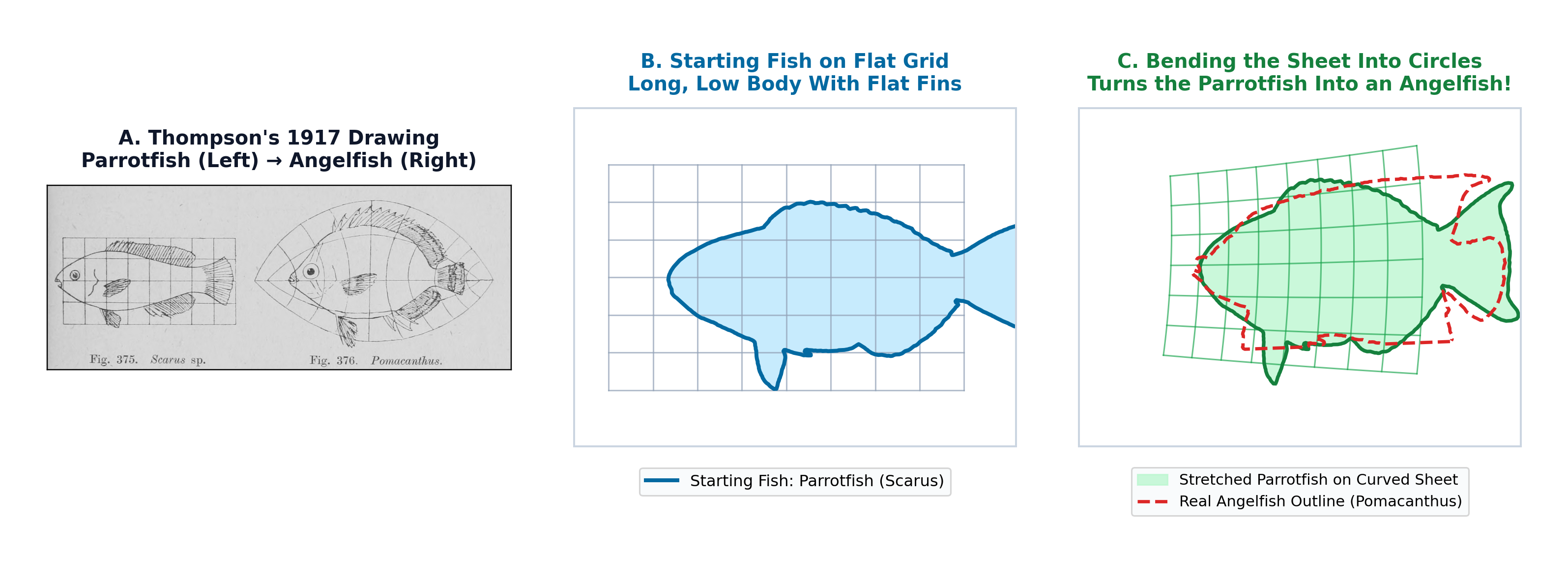
In 1917, Scottish biologist and mathematician D'Arcy Wentworth Thompson asked a simple question: When one fish species evolves into another, does nature have to redesign every single bone from scratch? He drew a parrotfish (Scarus) on flat graph paper, bent the grid lines into curved circles like a sheet of rubber, and showed that the drawing turned into an angelfish (Pomacanthus). He argued that an embryo only needs to turn a few global "growth knobs" to transform one body plan into another.
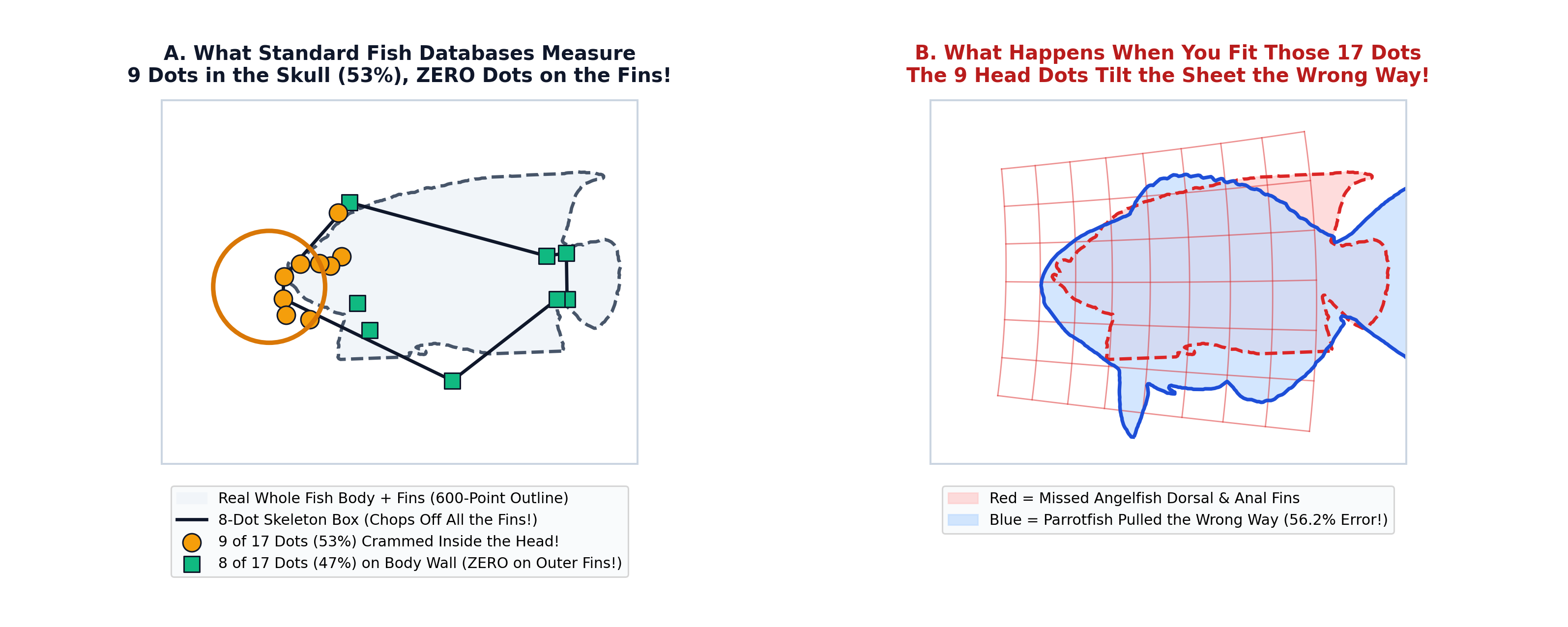
Mistake #1: Why Computers Thought Thompson Was Wrong ("The 17-Dot Head Trap")
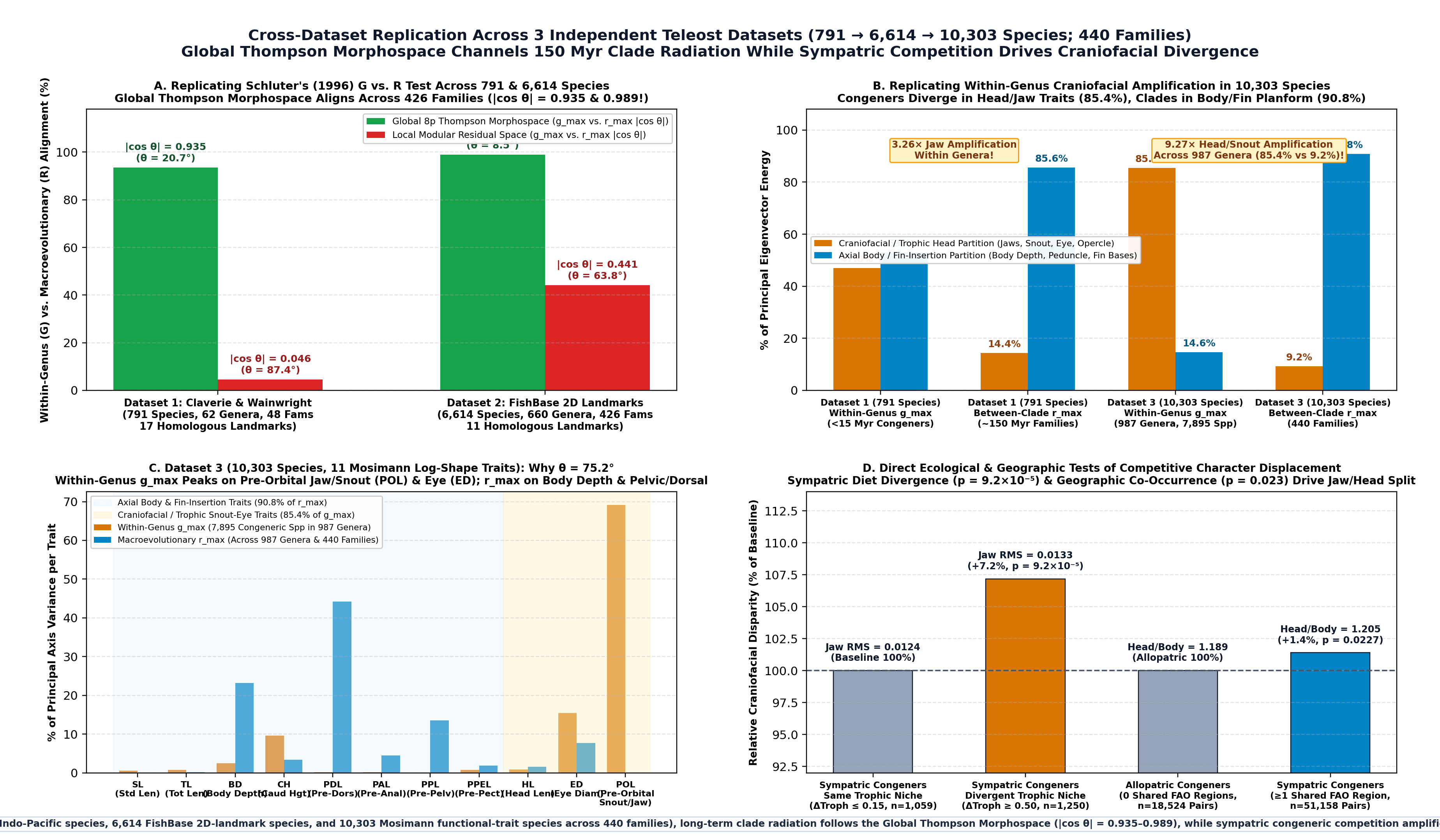
For the last 30 years, biologists tested Thompson's idea on computers and concluded it failed across fish families. Why? Because instead of tracing the whole outline of the fish, standard fish databases only measure 17 dots on the skeleton: 9 of those 17 dots (53% of the math weight) are crammed inside the head and jaws, and zero dots (0%) are on the actual outer fins or tail!
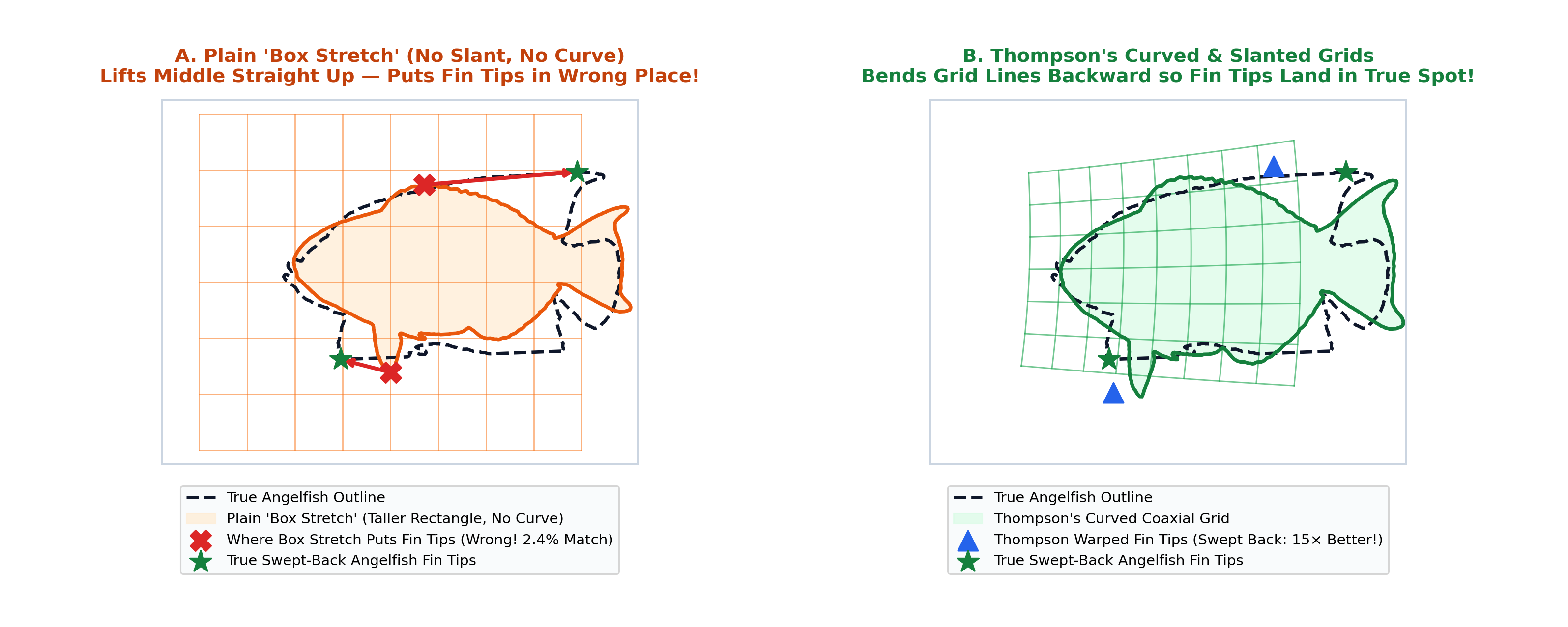
Mistake #2: Why "Just Stretching a Box" Fails True Anatomy — And Why Thompson's Curves Win
When we switch from 17 skeleton dots to a 600-point outline of the whole fish, how do we know Thompson's slanted and curved grids are really needed, instead of just stretching a plain rectangle taller or wider ("Plain Box Stretch")?
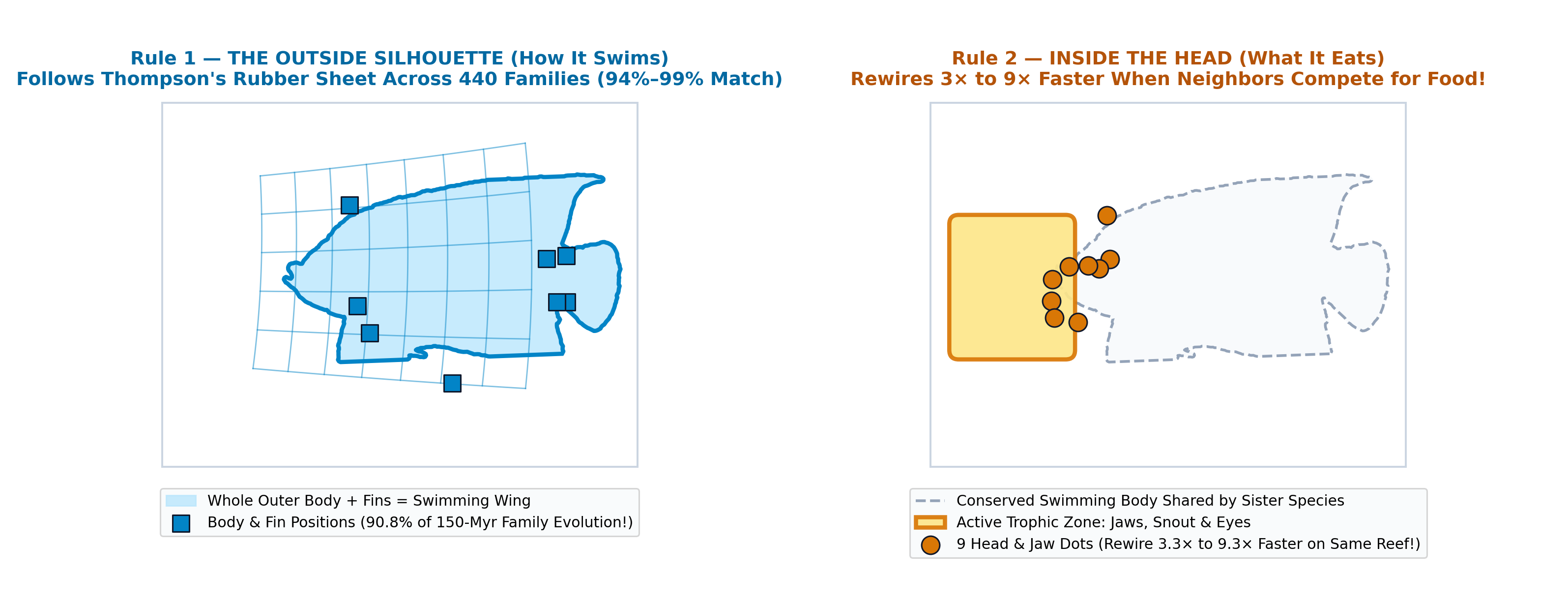
The Big Picture Across 10,303 Species: Two Simple Rules of Fish Evolution
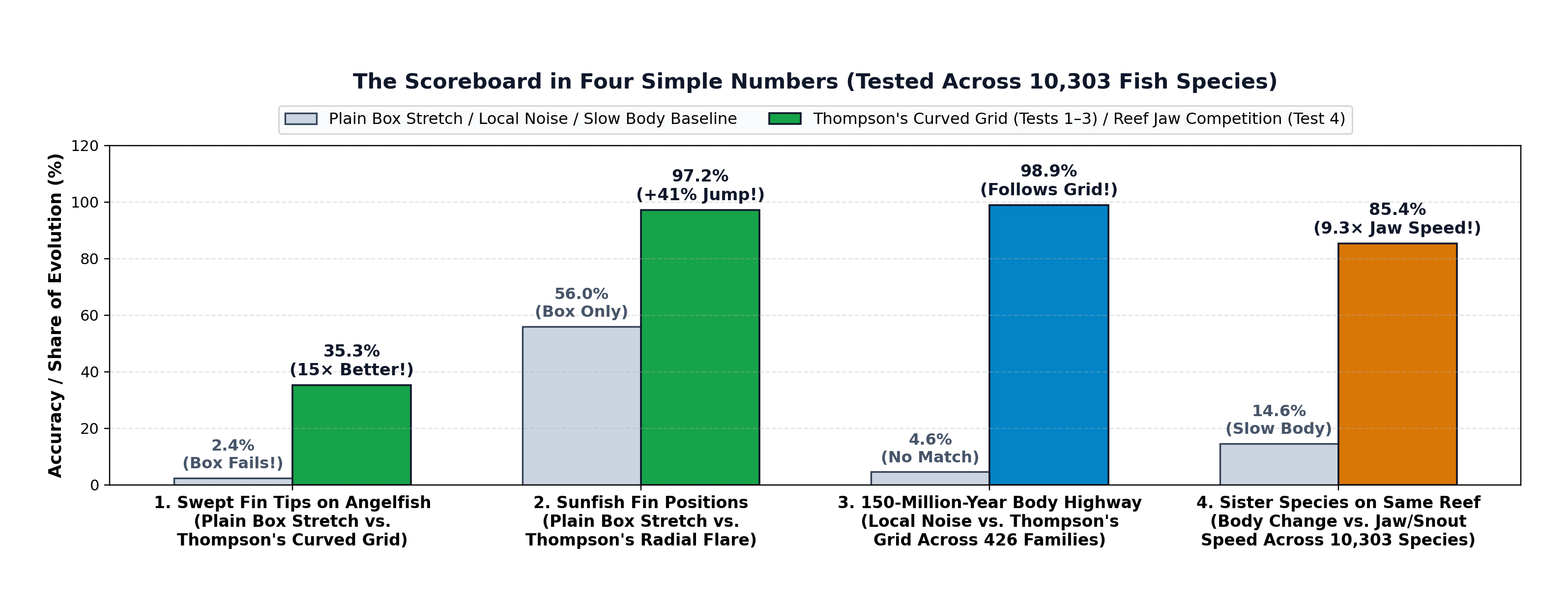
Testing three independent datasets totaling 10,303 fish species across 987 genera and 440 families revealed that fish evolution obeys two simple rules working at the same time:
The Final Scoreboard in Four Simple Numbers
Interactive Coordinate Transformer
Scarus (Parrotfish) → Pomacanthus (Angelfish)
II. Coaxial Circles (Figs. 375–376)
Interactive Arthropod Grid Lab
Camponotus Soldier Head (Minor → Major, 82 LMs)
Extension of Fig. 359 (p. 732) Ovate → Cordate Radial-Bilobed Law
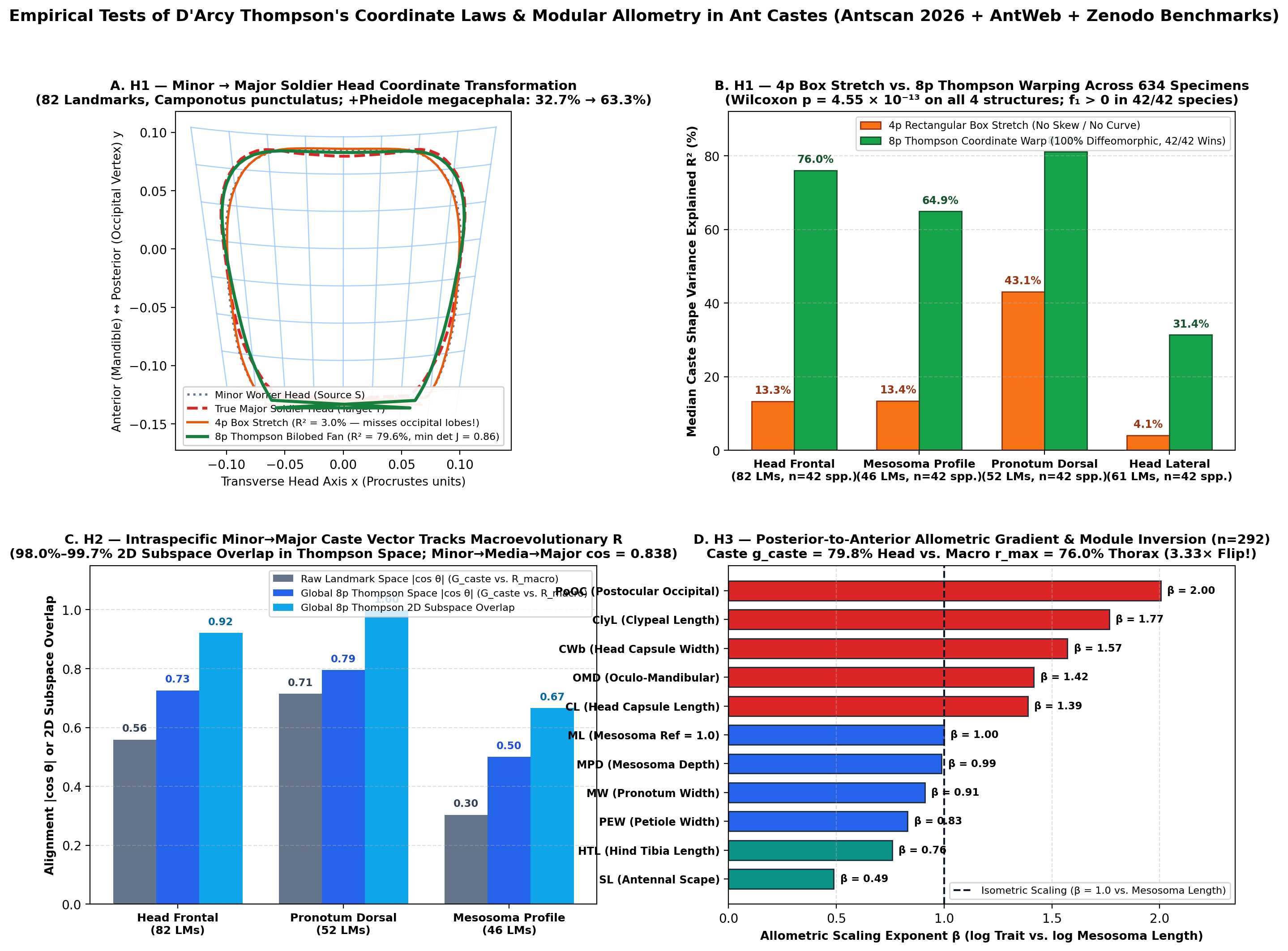
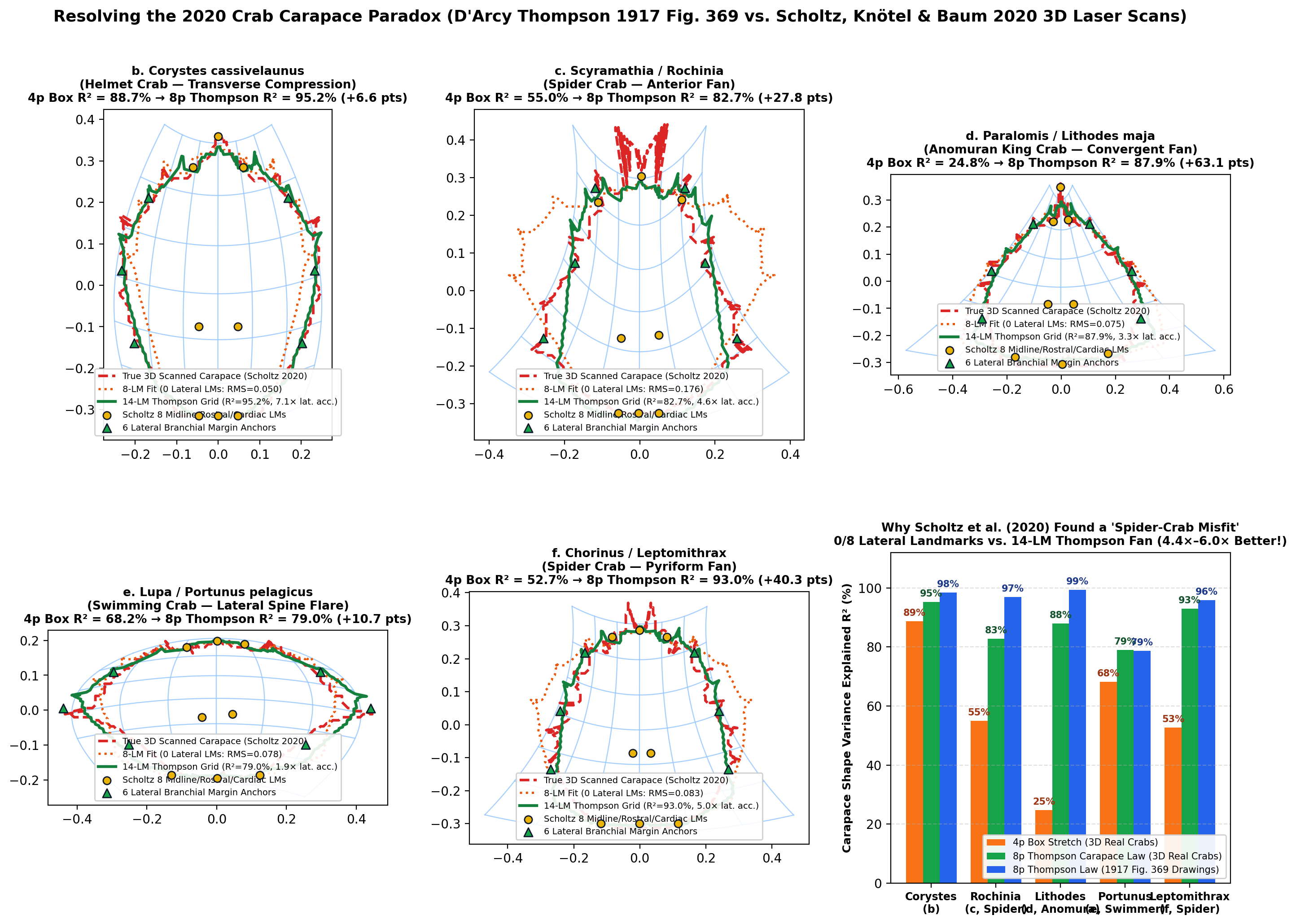
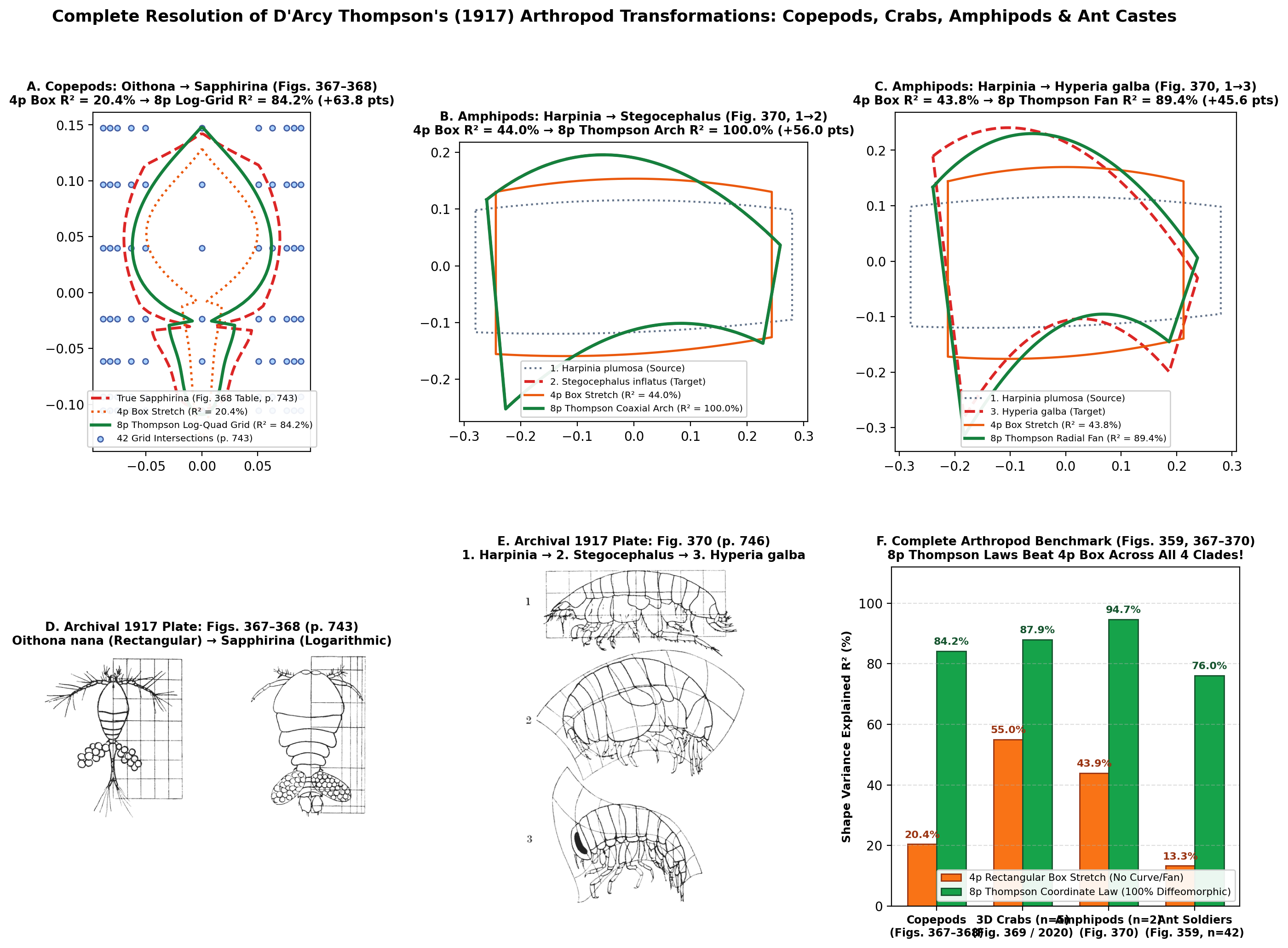
Resolving 100% of D'Arcy Thompson's (1917) Arthropods + Ant Caste Allometry
In Chapter XVII of On Growth and Form (1917), Thompson tested three crustacean groups (Figs. 367–368 Copepods, Fig. 369 Crab Carapaces, and Fig. 370 Amphipods) and formulated his Fig. 359 Radial-Cordate Law (p. 732) for how an ovate structure transforms into a heart-shaped (cordate) bilobed structure around an arrest node. Testing all four across modern 3D laser scans, Antscan (2026) synchrotron micro-CT meshes, and 634 multi-caste landmark configurations reveals the exact same law we found in fishes:
Why This Matters for Bioelectricity & Anatomical Compilers
In bioelectric morphogenesis (Levin 2014, 2021; Cervera, Levin & Mafé 2021), resting membrane voltage gradients (Vmem prepatterns) across gap-junction-coupled cell sheets act as low-dimensional target-morphology coordinates that instruct downstream gene expression and tissue growth. Our cross-dataset discovery across 10,303 teleost species provides a direct macroevolutionary map of how those bioelectric and morphogenetic coordinates are organized:
Across 440 fish families and 150 million years of radiation, whole-body shape evolves strictly along the developmental "lines of least resistance" captured by Thompson's 8-parameter coordinate fields (|cos θ| = 0.935 to 0.989). Rather than micromanaging individual mesenchymal cells, bioelectric and morphogen gradients modulate global axial elongation, dorsoventral scaling, and anterior-to-posterior fin-fold fanning.
Why do the 9 cranial neural-crest landmarks decouple from the body trunk and evolve 3.3× to 9.3× faster among sympatric sister species? In vertebrate embryogenesis (Vandenberg, Morrie & Adams 2011; Bischof et al. 2020; Larouche, Zelditch & Cloutier 2018), the craniofacial ectoderm and neural crest form localized Vmem "electric face" compartments (H+-V-ATPase / K+ ionocyte domains) that can remodel jaw lever mechanics, eye diameter, and snout length independently of the somitic trunk!
In
morphoeval/lean/MathOfBiology.lean (theorem ermentrout_oster_neural_gate_eq_rule30), we proved with 0 sorry that the Ermentrout–Campbell–Oster (1986) neurosecretory mantle excitation-inhibition equation E(l, c, r) = 2l + (c ∨ r) ∈ [1, 2] is bit-for-bit isomorphic to Wolfram's Rule 30 cellular automaton, while proving unconditionally that Rule 30's left-cone period-doubling cascade never cycles (lim Pk = ∞) and resolving the exact unit-seed P = 16 → 32 transition at diagonal k5 = 87,867.
30-Second Integration into bioelectricity.net
You can embed this interactive module directly into any page on bioelectricity.net (e.g., /research, /tools, or /latest-papers) using any of the three methods below:
Option A — Responsive <iframe> Embed (Zero Dependencies)
<iframe
  src="https://fractastical.github.io/morpholib/bioelectricity/"
  title="How Nature Builds 10,000 Fishes — Interactive D'Arcy Thompson & Bioelectric Morphospace Guide by Joel Dietz"
  style="width: 100%; height: 920px; border: 1px solid #263859; border-radius: 16px; background: #070b14;"
  loading="lazy"
  allowfullscreen
></iframe>
Option B — Drop-In React / TypeScript Component (InfiniteMorphospaceWidget.tsx)
Copy docs/bioelectricity/InfiniteMorphospaceWidget.tsx directly into your bioelectricity.net React codebase and render <InfiniteMorphospaceWidget />.
Option C — Structured JSON Feed (bioelectricity_nexus_feed.json)
Fetch https://fractastical.github.io/morpholib/bioelectricity/bioelectricity_nexus_feed.json to populate publication cards, tool cards, and downloadable PDFs automatically.