Three reproducible experiments on real human neuroimaging (plus one exploratory aside). We turn the brain's structural wiring into a graph, take the eigenmodes of its graph Laplacian (the connectome's harmonics), project resting-state fMRI onto them, and ask what changes under a psychedelic. Every result below is interactive.
Experiment 1
Does LSD reorganize the harmonic spectrum?
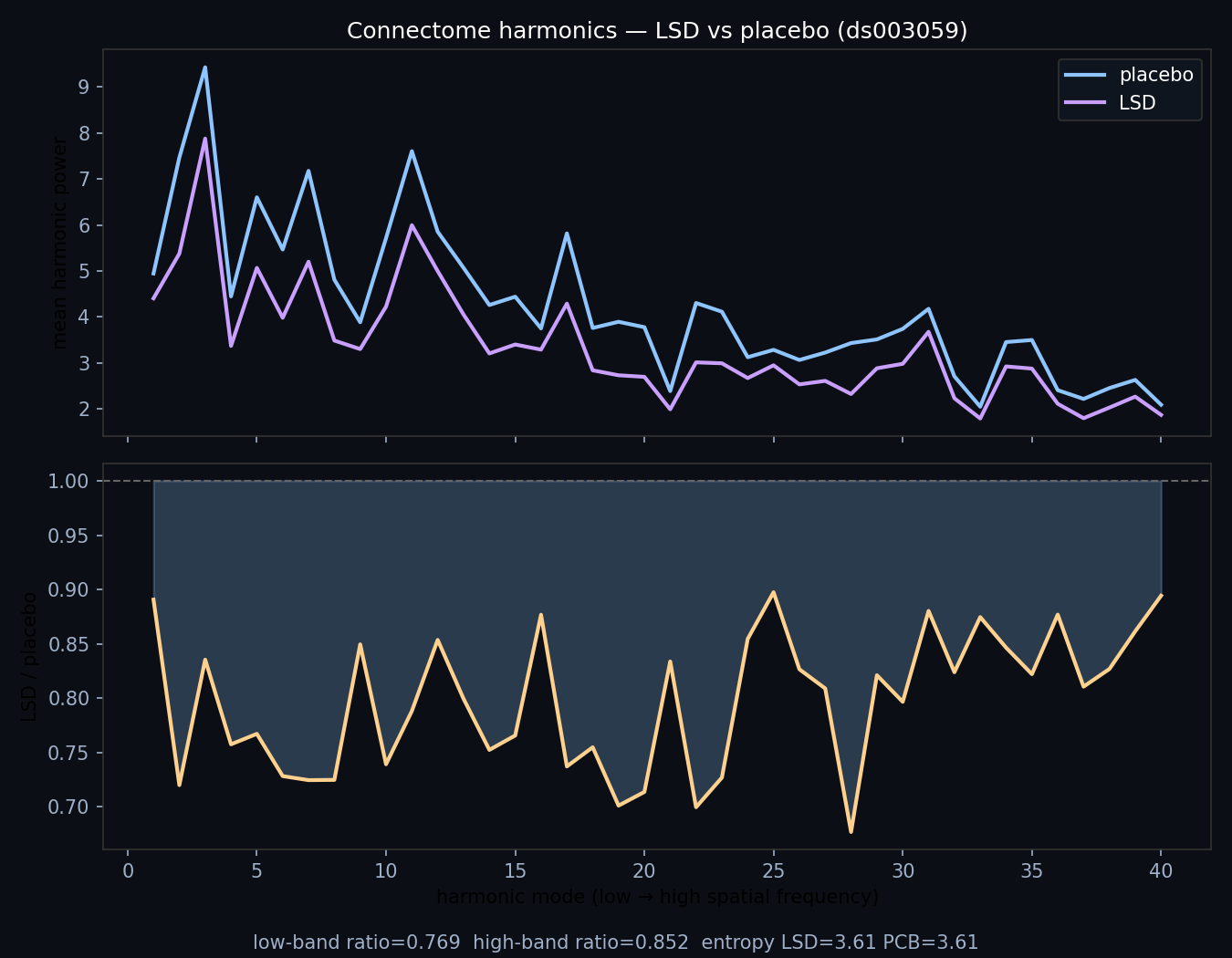
Method: project ds003059 BOLD onto the HCP connectome harmonics (parcellated, CHAP-style) and compare power per mode, LSD vs placebo.
Yes. Low-frequency harmonics lose power under LSD — the direction reported by Atasoy 2017.
low-band LSD/placebo ≈ 0.77high-band ≈ 0.85
Experiment 2
Is there a geometric “latent space” in the brain?
Method: use the lowest harmonics as coordinate axes (a Laplacian eigenmap) and embed all 400 regions — no functional labels given to the algorithm.
Yes. The seven Yeo networks fall into a continuous layout that emerges from connectivity alone.
Default-mode ↔ Visual along mode 1unsupervised
Experiment 3
Shape vs wiring — and does LSD move the winner?
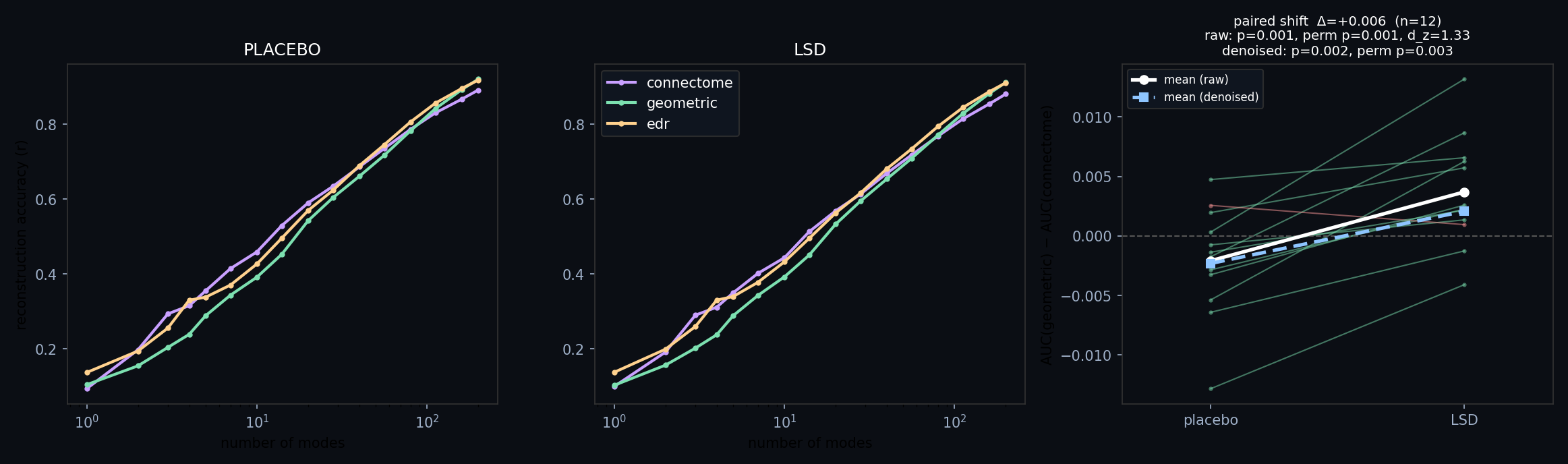
Method: reconstruct BOLD from the first N vectors of three bases (connectome, cortical geometry, distance rule); paired test of the geometric−connectome advantage, LSD vs placebo.
A tie at rest — but LSD shifts it toward geometry. The geometric basis reliably gains on the connectome under LSD.
ΔAUC +0.006paired t(11)=4.60p=0.0008d_z=1.3312/12 subjectsholds after GSR + permutation
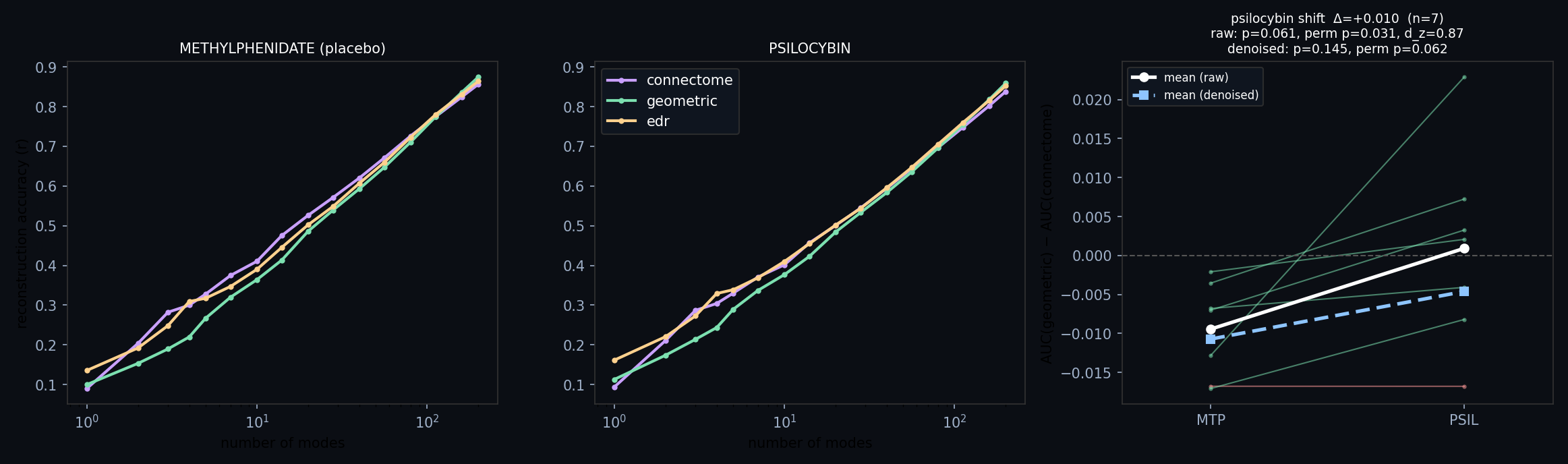
Replicates in psilocybin. An independent cohort (ds006072, n=7) shows the same geometry-gains direction.
ΔAUC +0.010perm p=0.031Wilcoxon p=0.031d_z=0.87t p=0.061 · marginal after GSR
Exploratory aside
Does the psychedelic brain become more “harmonious”? (STV)
A niche, speculative theory of consciousness — included as a falsification probe, not a core claim.
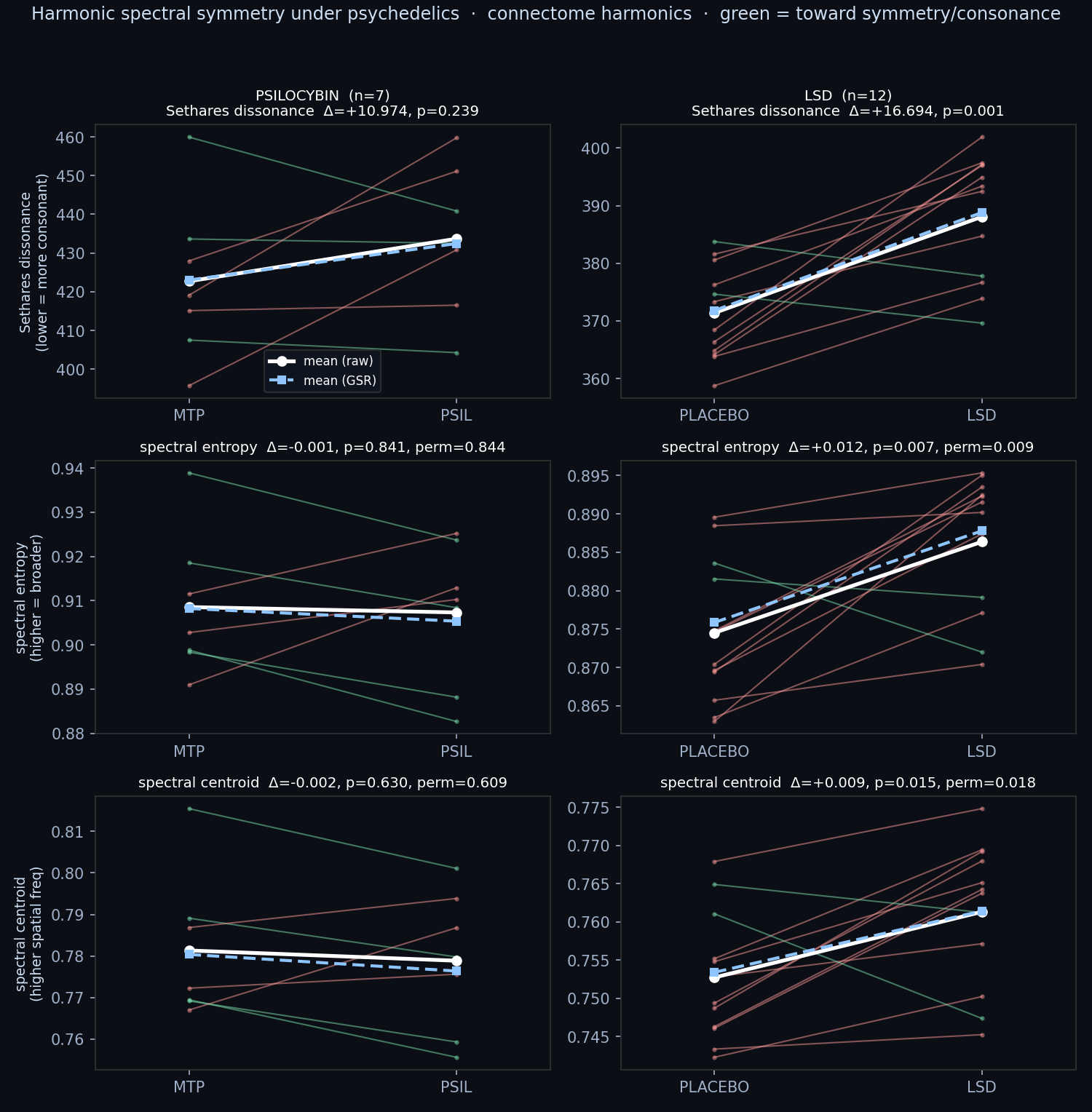
Method: score the consonance / spectral symmetry of the connectome-harmonic spectrum (Sethares dissonance, entropy) — paired test, drug vs placebo.
No — it gets less consonant. Against the naive STV prediction, the harmonic spectrum becomes more dissonant and broader under LSD (the “entropic brain” direction).
dissonance ↑ p=0.001d_z=1.24entropy ↑ p=0.007holds after GSR + permpsilocybin: same direction, n.s.